Postcards from a Snowy Paris

Although it snows occasionally in Paris, it seems to be rare enough that only a small amount wreaks havoc. The city just isn’t prepared for snow. Parisian winters are normally mild, but there have been some very cold ones that have brought great hardship. Fortunately, Parisians are a resilient lot. Disaster after disaster, they survey the scene and get on with fixing the damage and carrying on with life.

The image above seems timeless, with the workers in their hooded coats, wielding twig brooms and flat shovels. They are clearing what appears to be a light snowfall. (We cannot identify the location. Can any reader out there suggest where it might have been taken?)

That timeless scene seems a far cry from the “vigorous” winter of 1879-1880, when heavy snows and frigid temperatures led one newspaper, Le Petit Parisien, to put Paris and Greenland in the same category. It was an exceedingly difficult time, when trains moved no faster than pedestrians (if at all), telegraph services went down, and many apartment dwellers found themselves without the all-important gas needed for heating and light.

The roof of the Saint-Martin market collapsed under the heavy snow load. Fortunately, the market was closed and no one was killed. The temperature dropped as low as minus 21°C. For those who like numbers, 12,000 workers were hired to clear seven million cubic metres of snow. Even after converting that to seventy million cubic feet of snow, I’m still not sure what it means. An awful lot of snow, I guess.

But in the postcard, an aura of calm dominates the scene. The snow on the rooftops is more scenic than threatening, and the two figures just visible on the left edge seem unhurried. From the stamp cancellation on the front of the card, we know it was mailed from Paris in 1909.

The destination is shown on the back, as well as in the second postal mark. It is the town of Mennecy south of Paris in the département (administrative region) of Seine-et-Oise.

The next three cards, taken one year later, are from one of the great natural catastrophes in Parisian and French history: the Great Flood of January 1910, the likes of which Paris had not seen since 1658.
Snow-covered umbrellas dominate the foreground. It is quite unlike the first postcard, where there is only one umbrella and no sense of urgency. In this image, snow-covered roofs seem threatening, as do both the water in the street ahead and the boat floating where normally one would walk.

No single event triggered the flood. A series of unusual weather patterns accumulated and built on each other. The summer of 1909 had been cold and rainy. Sodden land held as much water as it could and the rest ran off. Fall and winter came with more rain and snow. As the New Year approached, it rained even harder and temperatures rose. Under the double load of meltwater and heavy rain, the Seine began to rise, causing small floods here and there. That was serious, but not a crisis. Then, on January 9, 1910 the rains came down even harder and by the January 14, the river was in full flood. And on some days the rains turned to snow.

This photo, taken on January 23, 1910, is both sad and threatening. By this time Paris had suffered serious damage. Thousands of homes and businesses had been flooded, not to mention the Metro, but Parisians soldiered on. Temporary sidewalks on stilts were erected so people could get to and from work, buy food and wine, and get on with their lives.

And what did those huddling on shore in the cold think of the struggling pleasure boat that advertised “Pianos on Board”? Perhaps they had dined and danced there once. Did it all seem irrelevant, perhaps even mocking? Or did it remind them why Paris, no matter what, was the pleasure capital of the world, a city of joy that sometimes suffered catastrophic interruptions? The waters would go down eventually, and the fun would resume on the boat and elsewhere.

The great flood of 1910 was not confined to Paris. The Seine is a long river and many outlying areas were flooded. At first glance, this image from Nanterre seems calm and the snow on the roof pleasantly scenic. On closer examination, you can see the height of the water. Nanterre is downstream from Paris, but close enough to be regarded as a suburb. This card, and the one below are from a series showing the damage done to Nanterre during the flood.

This second image shows an artificial gas facility where the coal in the right foreground would undergo what we call destructive distillation (heating to high temperature in the absence of air) in ovens or retorts inside the building on the right. The heat drove off gases which could be collected and stored in the gasometer on the left and distributed from there by gas lines. This was the artificial gas that powered, heated, and lit so many buildings and businesses in the 19th century. I wonder if the plant shown here had to shut down as a result of flood damage.

But cold temperatures and snow can also bring pleasure. The final postcard shows an idyllic winter scene in the Bois de Boulogne, one of the great Parisian parks. There is a lot going on. Some people are standing around talking, and some skating. When I first looked at the card I was puzzled by all the brooms. Are these the twig brooms we see in so many paintings and photos of Paris? Today the shape is fundamentally unchanged, but the bristles are no longer twigs but fluorescent green plastic.

After I had scanned the postcard and looked at it on a large screen, I could see that they were clearing individual skating areas. On the right I could see someone using a flat shovel similar to that in the first postcard. Near the middle is a wonderful apparatus—a chair of some sort mounted on runners and being pushed by a skater.

Yes, winter can be wonderful. The image of people enjoying the a cold bright day brought back memories of Christmas Day, 2010, when Philippa and I wandered through a snowy Jardin du Luxembourg. I shall always remember the young men playing table tennis in the snow. Come snow, come rain, Parisians always seem to find a way to have fun.

Text by Norman Ball

Posted in Paris history, Paris parks, Paris postcards | Tagged , , , , , , , , , , , , , , , | 3 Comments

Colour commentary

In the 1840s, my great-great grandfather came to Paris to study at the Gobelins Tapestry Factory. He was not a weaver or tapestry-maker, but a chemist who specialized in the science of colour and dyes, and the Gobelins was the centre of colour technology at the time.

I like the idea of my ancestor studying colour in Paris. To me, the city is all about colour. Consider the art supplies in the shop Sennelier on the left bank.

Or the colours on display at any of the city’s flower shops, market stalls, or fabric emporiums.

But where I really love to find colour is on Paris’s façades. Interestingly, colour in architecture is considered controversial. Back in 2008, the Pavilion de l’Arsenal presented an exhibition called “Accords chromatiques” and published a book by the same name by Simon Texier. The opening line of the description was: “What if Paris were not the monochromatic city that is so often described?”*

Some architects frown on the use of colour, considering it vulgar, or a way to hide design flaws. Real architecture, they believe, is pure form and structure, colour is just a distraction. (You can even get into gender politics in this discussion – men are monochrome, women are all about colour…but let’s not go there now.)

The anti-colour faction was strong in the 18th century, but colour re-emerged in 19th century architecture, partly with the revival of interest in colourful medieval buildings – indeed the discovery that what are now monochrome church facades were once brightly painted. The 20th and 21st centuries seem to be divided into two camps on the subject – some pro, some anti colour.

Over the years, many of those who study architectural history have seen it largely through the medium of engravings or etchings or black-and-white photography, not realizing that the subjects in the photographs may have been colourful. The past was not sepia-toned for those who lived in it.

Of course, there is colour and colour. Some of it is fairly subtle. For example, there are at least 17 different building materials of different hues on the façade of the Opera (even before you consider the gold roof or the gilded mosaics), ranging from green Swedish marble to red stone from the Jura. Alain-Charles Perrot, the architect who supervised the restoration in the late 1990s, mapped them all so that replacements could be sourced from the original locations as much as possible.

Then there is the in-your-face colour of the Pompidou Centre, which looks like an oversized child’s toy.

In between are all kinds of gradations – facades with a little or a lot of coloured ceramic tile or mosaics, or those enlivened with painted walls or doors or shutters. Just as I am addicted to photographing courtyards, I tend to get out my camera when I see a particularly interesting touch of colour.

Consider this façade in the 16th on the rue de la Pompe. It is now a restaurant, but started life as a flower shop.

I was intrigued by the Chinese look of the entry to the Lycée Molière on the rue du Ranelagh.

I loved the faded pink on this down-at-the-heels hotel…

…and the bright yellow on this half-hidden door in the rue des Thermopyles.

I nearly missed this detail around the windows on the rear façade of the Bon Marché, which is half-hidden by the overhang of the canopy.

In fact, if you like colour, the grands magasins are awash in it. This façade of La Samaritaine is practically nothing but glass and mosaics, with some iron beams holding the whole thing together.

One of the most enthusiastic exponents of the use of colour in architecture was the architect Paul Sédille, who created the colourful façade of Printemps when he restored the building after a fire in 1881.

Sédille worked closely with Jules Loebnitz, whose company made earthenware tiles that did not crack or break when used on façades. Together, the two added colour to many Paris commercial and exposition buildings.

When I looked up Sédille (1807-1900) in an encyclopedia of French architects active in the 19th century, I found that he had designed one of the most colourful houses I have ever seen in Paris at 32, rue Eugène Flachat.

The other side of the house is visible at 51, boulevard Berthier. Same colour, but with a different treatment and different motifs in the mosaics. And yes, the bricks and tiles came from Loebnitz.

I was fascinated by this peacock of a house, and wanted to know more.

At the moment, the house appears to be used as offices. It is listed on the Internet as the address of the headquarters of Monceau Fleurs and the Centre de Formation Professionnelle des Fleuristes Modernes – appropriately enough – as well as the office of an architectural company called Build Up.

The encyclopedia of architects notes that it was built in 1892 for “F.-G. Dumas.” This turned out to François-Guillaume Dumas, editor of Paris Illustré and the Revue Illustrée, publisher of art catalogues, and author of an 1889 guidebook called Paris, ses vues, places, monuments, théâtres, etc.

Clearly this art publisher was making a strong statement in favour of colour in architecture. Some might find the colour a bit overpowering, but right now, in the middle of February when Paris is suffering through a rare snowy spell, the jolt of turquoise could be quite therapeutic for passers-by.

Text by Philippa Campsie; photographs by Philippa Campsie and Norman Ball, except for the photograph of Printemps, which comes from Wikimedia Commons.

* Et si Paris n’était pas cette ville monochrome que l’on nous décrit souvent ?

Posted in Paris architecture, Paris art, Paris streets | Tagged , , , , , , , , , , , , , , , , , , , , , , , | 3 Comments

Dateline Paris 1900: The Astounding Moving Electrical Sidewalk

In 1900, if you were lucky enough to have a ticket such as this one—and almost fifty million people did—you were in for an astounding treat. Paris and France went all out to make the Paris Universal Exposition the biggest and best yet anywhere in the world.

Although the Exposition seemed to have something for everyone, two words capture much of the spirit and substance of that great event: electricity and motion. As Charles Rearick writes in Paris Dreams, Paris Memories:

The fifty million visitors who came to the ‘Exposition Universelle’ were met with a dazzling profusion of electric lighting—in the pavilions and the Palais de l’Électricité and all the way up the Eiffel Tower. Outside the fairgrounds, the new lights illuminated the city’s monuments and the central boulevards.*

The newly constructed Pont Alexandre III led to the grounds, and provided lovely stopping points for flâneurs, flâneuses, and families. The ornate lamp standards might have looked like something from a far earlier age, but they were illuminated electrically: electricity and motion. Many who crossed the bridge would have travelled on the newly opened Métro in electrically driven cars: electricity and motion again.

For me, nothing captures the spirit of the Universal Exposition better than the image below.

It is a view of the Place de l’Ecole Militaire, looking towards l’avenue de Tourville on the right and to the left, l’avenue de La Motte-Picquet. There is plenty of motion at street level. But what of the two elevated roadways? On the left passengers are being treated to a ride on an elevated electric railway. The other simply looks like an elevated roadway or sidewalk.

Look more closely at the happy group standing above. They don’t seem to be walking. There are more people behind them, also standing still. Why is there a semi-circular section on the sidewalk? And what are the waist-height poles to the left? Do you see the hand on top of one? We need to look at some other photos.

Here is another calm scene on the elevated sidewalk or roadway or whatever it is. On the left is a group standing on the sidewalk. We also see the poles in two distinct lines and note that the sidewalk is actually on three levels. And the wooden planks on the two higher levels follow the direction of the sidewalk and the lower level is at right angles to the direction of travel. Notice what looks like a station or shelter further along the sidewalk on the right side.

This was taken beside the building we saw in the previous photo. The child in the foreground seems to be a little unsure of his footing. Perhaps the man with what appears to be a porter’s or conductor’s cap is helping to keep the child from falling over. Beside the child, a man appears to be helping a woman move to the highest level of the sidewalk. Their images seem blurred because they are unsteady. It seems a rather animated scene. But the next is even more so.

There is a lot going on. The man on the right wearing a bowler (or fedora) is rushing forward with hand outstretched to rescue a woman who is falling over. She is taking quite a tumble, he won’t get there in time, and she is going to hit the railing and the wooden sidewalk. Further back: more action. A woman is moving from the second to the third level; one skirted leg is thrown back. The lady with light coloured skirt, hat and parasol seems fine. Moving over to the left again, the lady wearing a dark skirt and the child are holding hands and both seem bent over determinedly. They seem to be bucking the wind or are leaning forward as if they had just got onto something moving and did not want to be thrown backwards. The two figures on the left, the man leaning on a railing and a woman admiring the view, are pictures of composure.

We have been looking at le trottoir roulant, the moving sidewalk, which in its day was one of the most famous marvels at the Universal Exposition of 1900. Historian Anne Friedberg writes:

The Paris trottoir was a two-mile-long, electric, three-tiered sidewalk. One trackway was stationary, the next moved at two-and-a-half miles per hour, the third at five miles her hour. The moving boardwalk moved bodies to see the grounds from new points of view at new speeds of movement. And the walkway itself was an exhibit, as patrons could sit and watch fellow fair-goers mechanically stroll.**

To get a real sense of what the experience was like (we suspect that the image above was staged), check out the video here. The film-maker? Thomas Edison. Notice how the passengers grab hold of the posts to swing on and off the sidewalk.

Alas, like the Gigantic Wheel at the same fair, le trottoir roulant had been preceded by a version at the Chicago World’s Columbian Exhibition in 1893. It shares something else as well.

Most of the grand structures and attractions built for great expositions are rather short-lived. The Eiffel Tower is a magnificent exception. In this street-level view of the moving sidewalk above, we see the support structure is rather roughly made of heavy wooden timbers. It was intended to be temporary and was eventually torn down.

Today the idea of a moving sidewalk does not seem at all novel. As we rush through airports wishing the moving sidewalks would go faster or as we travel on them in the Paris Métro—particularly that very long stretch in the Montparnasse station—we might pause to think of a time when they were novel, and if you got it just right, actually enjoyable.

Text by Norman Ball; images from the Roger-Viollet collection, Paris en images

* Charles Rearick, Paris Dreams, Paris Memories: The City and Its Mystique (Stanford University Press, 2011), p. 13.
** Anne Friedberg, “Trottoir roulant: the cinema and new mobilities of spectatorship,” in John Fullerton and Jan Olsson, eds., Allegories of Communication: Intermedial Concerns from Cinema to the Digital (John Libbey Publishing, 2004), p. 265.

Posted in Paris expositions, Paris metro, Paris popular culture | Tagged , , , , , , , , , , | 3 Comments

Sailing ships and rowboats

Père Lachaise Cemetery, spring 2010. I took this photograph, wondering what on earth a “caveau depositoire” might be. Turns out it is a temporary storage spot for bodies awaiting burial. But what attracted my attention at first was the image of a ship on what at first appears to be a headstone, but is in fact, simply an identification marker on a civic property.

The ship is, of course, the symbol of Paris, and you see it everywhere – on municipal buildings and facilities, including this one in the cemetery. I have photographed many others, from this unusual street sign on the rue de Penthièvre …

…to the tiny one on this marker indicating the boundary stone between Passy and Auteuil on the rue Berton.

But it was only when I put together a little collection of these photos that I noticed something odd. Consider, for example, this elaborate version, on the dome of the Petit Palais.

It has oars. Three oars and three sails. The cemetery version had three sails, but no oars, and many of the others have one sail and no oars. Clearly there is no consistent corporate identity here.

French Wikipedia notes that the coat of arms may have one, two or three masts and might or might not have oars. It also shows the standard version and two interesting alternatives.

The current one, shown above, is based on the original 14th century form – a rather unseaworthy-looking craft resembling no known boat shape (a semicircular profile with a single sail on top), perched on some choppy-looking waves.

The second, from the First Empire, includes bees, symbol of the Emperor Napoleon, and a star, symbol of the army, with a more stable version of the ship. It has an Egyptian figurehead at the front (Isis) and an inverted cross at the back. The former alludes to Napoleon’s military victories in Egypt, I suppose. The latter gave me pause. It was originally the symbol for St. Peter (although it is now associated with black magic). The allusion to St. Peter might have something to do with Napoleon’s takeover of the Papal States.

There is a third version, from the Second Republic (1848-1853), with a bigger, three-masted ship, and stars replacing the fleur-de-lys, which were associated with the recently overthrown royal family.

But not one of these ships has oars. And oars are clearly important, because they are what the city uses to indicate historic locations.

Oars are also prominent in the symbol the city used for the 1924 Olympics.

The inconsistency interested me. So I did a little research on the coat of arms.

The choice of a ship to symbolize Paris was the decision of Charles V in 1358. I’ve seen a couple of theories about why that particular symbol was chosen.
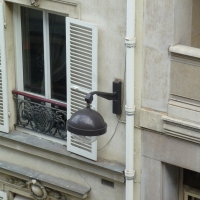
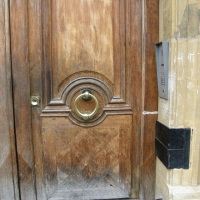
One is that the ship represents the boat-shaped Ile de la Cité, which once constituted the entire town. The oars are the bridges connecting it to the banks on either side. It’s an attractive theory, but probably not historically accurate.

More likely is that the ship represents the powerful guild of the Marchands de l’eau, who dominated the city from its earliest days. Although they sound like water-sellers, in fact this was a guild of boatmen who dominated waterborne trade on the river. What kind of boats would they have had? How big were they? Did they use sails or oars or both?

Both the Romans and the Vikings had ships that combined sails and oars, but they were sea-going ships, rather than rivercraft. And by the medieval period, when the Paris coat of arms came into use, boats had one or the other but usually not both – at least, if the images on the Bayeux tapestry are typical.

So the ship with sails and oars probably evokes the early history of the city the Romans called Lutetia.

In the end, the choice of what to portray seems to be left up to the individual artists and artisans who have created the endless variations of the coat of arms seen around the city. How dull if they were all the same.

And then there are the artistic opportunities in the additional elements of the coat of arms. This one, from the building overlooking the Montsouris reservoir, shows some of these. On top is a combination crown/castle or couronne murale (this one has four towers; some have five), symbolizing the autonomy of the city. There is also an oak branch on the left (a symbol of strength), and a laurel on the right (glory). And you can just see the banner with the motto “Fluctuat nec mergitur”: tossed by the waves, but not sinking.

Of course, exactly 102 years ago today, people were probably wondering about that last bit, as Paris struggled through the great flood of January 1910. Once again, the city depended on boatmen, and pressed rowboats and punts into service to ferry people through the streets. And the city, in the end, did not sink.

Text and original photographs by Philippa Campsie

Posted in Paris civic functions, Paris history | Tagged , , , , , , , | 3 Comments

The Paris Gigantic Wheel and Varieties Company Limited

It was an intriguing postcard, titled simply “Paris. La Grande Roue” (Paris, The Big Wheel). I didn’t recognize it, but I liked it, so I bought it. Little did I know that this purchase at an antiques fair in Paris would lead me to the Paris Gigantic Wheel and Varieties Company Limited and some unusual stories.

Can you imagine someone not recognizing the Eiffel Tower today? Well, in 1900 few in Paris could have imagined a future in which one would not recognize the Big Wheel. Ah, history and public memory can play such cruel tricks.

The back of the card is dated 10–12–18 (December 10, 1918, I gather) and contains a personal message from Jules to “ma cher petit [sic] femme” (my dear little wife). All we learn of the wheel is that Jules went up on it hoping to get a view of the Louvre from on high, but the day was too foggy. (You can see the message for yourself at the end of this post, if you are good at deciphering handwriting in French. And Jules had obviously failed dictée at school.)

Given the French leadership in artistic advertising, there is no shortage of images such as the one above. One is left with the impression that this great wheel is the centrepiece, the pride and joy of the 1900 Universal Exposition in Paris.

At 106 metres (over 300 feet), it was the tallest panoramic wheel to date and it would hold that record for more than eight decades, long after it had been torn down. Each of the 40 carriages carried 40 passengers and the arrangement of stairs and loading platforms was designed to allow passengers to get on or off 8 carriages at a time. With loading and unloading, each trip took 20 minutes. It was designed to transport 4,800 passengers an hour in cabins the size of railway carriages.

Much has been written about the wheel’s spectacular location in the exposition grounds dominated by the Eiffel Tower. Looking at a map or bird’s-eye view of the site, we can see that the Gigantic Wheel is actually relegated to a corner about as remote from the Eiffel Tower as possible, and its surroundings were a far cry from the carefully landscaped grounds of the Champs de Mars and the Eiffel grounds.

This is interesting, and suggests another question. Was the Gigantic Wheel hot news at the time or same old same old? Yes it was big, the biggest yet, but even when it opened, it was old hat. It traced its origins to another fair, at which an American engineer called George Washington Gale Ferris Jr. had an idea that would let the Columbian Exposition of 1893 in Chicago “out-Eiffel” Eiffel and his tower, which had opened four years earlier. His Ferris Wheel was huge and genuinely innovative. It was a big hit with the public, but a commercial disaster.

The Chicago Ferris Wheel sparked a series of imitations: first, at Earl’s Court in London (1895 for the India Empire Exhibition), then at Blackpool, a major tourist centre in northern England (1896), then Vienna (1897, to celebrate the 50th anniversary of the coronation of Austrian Emperor Franz Josef), and finally Paris (1899, in anticipation of the 1900 Exposition). And all these gigantic wheels were the creation of one man: Walter B. Basset, former British naval officer and hero, and managing director of the prestigious British engineering firm of Maudslay, Sons & Field. Much of the original engineering design was the work of a young engineer by the name of H. Cecil Booth.

Each grand or panoramic wheel used the same pattern of financing. Create a company and sell shares or debentures. The London company was The Gigantic Wheel and Recreational Towers Co. Limited, followed by The Blackpool Gigantic Wheel Co. Ltd., then the Vienna Gigantic Wheel (Wiener Riesen Rad) Ltd., and finally, the Paris Gigantic Wheel and Varieties Company Limited. This was formulaic entertainment, an investment in what I call the Technology of Tourism.

Somehow, the Paris Gigantic Wheel lacked the spirit of either innovation or bold design displayed by Eiffel in his 1889 Tower or by Ferris with his original wheel in Chicago in 1893. But the world was changing.

In an excellent book on the buildings and remains of Universal Expositions in Paris, Sur les traces des expositions universelles, Sylvain Ageorges calls the Exposition of 1900 a turning point. Earlier expositions, beginning with first at the Crystal Palace in London in 1851, were heavily didactic, perhaps too much so for many visitors.

But Paris 1900 was different. It was “plus joyeuse et populaire que les autres” (more playful and popular than the others, p. 110). In addition to the “grande roue de Chicago,” there were films by the pioneering Lumière brothers projected on giant screens 21 by 16 metres, and, at Le Phono Ciné Théatre, there were moving pictures synchronized to phonograph sounds.

The Grande Roue opened the year before the fair and was part of a larger area of restaurants, theatres, and other entertainments that was in full swing in 1899. It was at the southeastern edge of the more glamorous fair (where the avenue de Suffren is now) and seemed both far less imaginative and more relentlessly commercial. Today we might call it an entertainment district, like the tacky cluster of wax museums, cheap restaurants, casinos, and shops a stone’s throw from the majestic power of Niagara Falls.

The postcard above places the Big Wheel in what is called “le Wonderland.” Some accounts credit the creation and ownership of the Grande Roue to the French industrialist, Théodore Vienne, who had made his fortune in textiles and then turned to other pursuits, such as the Paris-Roubaix cycle race and boxing matches.

Vienne was a director and major shareholder in Basset’s Paris Gigantic Wheel and Varieties Company Limited. He appears to have been the force behind other attractions in the avenue de Suffren area, which was described as “un véritable kaleidoscope d’attractions.”

I don’t know when the area became known as “le Wonderland.” Perhaps it was in 1907, when Victor Breyer and Théodore Vienne opened the Wonderland Français Arena. This was the work of Vienne in his capacity as a boxing promoter. Some said he was none too scrupulous, but he did bring the big-name fighters to Paris.

One finds increasing criticism of Wonderland as an undesirable centre of music halls and boxing. Some said it was simply the changing tastes of the young 20th century. Whatever the reasons, the area’s reputation declined and it became seedier. This did not help traffic on the Gigantic Wheel. Its days were numbered; perhaps they had been so since its opening.

The photo above was taken in 1920 during the demolition of La Grande Roue. It didn’t even win a first in the demolition class: Earl’s Court operated for only 11 years and was torn down in 1907. However, perhaps La Grande Roue first showed us something that Blackpool would later confirm: a big wheel cannot win out over a grand tower.* Even though the view from the Gigantic Wheel was spectacular, it was a passive experience in which you sat, waited, and watched.

When the wheel was demolished, the spacious carriages were sent to northern France to serve as much-needed housing in an area where the ravages of war had taken its toll (according to Norman Anderson, Ferris Wheels: An Illustrated History, p. 110). One wonders if the shareholders who had bought into the Paris Gigantic Wheel and Varieties Company Limited to finance the wheel ever made any money.

So is the history of Grande Roue all over in Paris? Absolutely not. There is another. It has a stunning location near the Place de la Concorde and stays up for only part of the year. Some people would like it to stay all year. I hope not. Each year the opening and closing creates fresh excitement. The first Grande Roue ran out of excitement. Let us hope that doesn’t happen for the second Grande Roue de Paris.

Text by Norman Ball, with illustrations from his postcard collection, and from the Roger Viollet collection, Paris en Images.

* Blackpool learned its lesson early on. The wheel opened in 1896, but in 1916 the Blackpool Gigantic Wheel Co. Ltd. went into voluntary liquidation. The new owners hung on until 1928 when they closed it, and sold off the carriages to people who converted them into storage sheds, living accommodations and even a café. When the Blackpool wheel opened, residents wondered if it would take business away from the popular tower. It didn’t.

Posted in Paris expositions, Paris history, Paris popular culture, Paris postcards | Tagged , , , , , , , , , , , , , , , , , , | 10 Comments

The 37 Steps

It’s January, and the papers are full of recommended diets to deal with the extra pounds we all gained over Christmas. Oh, phooey. I’ve got a great book on French food that is making me hungry just reading about it and my niece Alex has started a recipe project and blog and invited contributions. Forget the diet, there is cooking to be done.

I’ll start with the blog. It’s very new still, but Alex has committed to trying one new recipe a week for the whole year, and my sister and I are weighing in with our ideas, along with some of Alex’s friends. So do drop by and take a look: it’s called Eat and Two Veg.

As for the book, it’s by two people we have never met, but with whom we have a lot in common. Diane Shaskin and Mark Craft are a husband-and-wife writing team, just as Norman and I are. They are Canadians who are indifferent to hockey and have no objection to green Christmases. They travel to France as often as they can. And when a friend asks “You’re going back again?…Haven’t you been there, done that?” Diane’s response is, “I haven’t been to France for six months…I mean, it’s perfectly obvious, isn’t it? Think of all the things I’ve missed during those months. Parisian life is going on without me!”

But of course. Why go anywhere else? You can find new places, have new experiences, voyage into the unknown, without leaving Paris. And at the same time you can enjoy familiar scenes, revisit old haunts, and rejoin friends. The perfect combination.

Diane and Mark’s book is called How to Cook Bouillabaisse in 37 Easy Steps: Culinary Adventures in Paris & Provence.* Don’t let the title scare you. It’s sort of a journal/scrapbook/cookbook. There are short chapters on Diane and Mark’s experiences dating back to their first trip to France 20 years ago, brief explanations of various French foods, memorable menus, preparation tips, photographs, a list of Provençal markets, and a directory of favourite Paris restaurants. And plenty of non-intimidating recipes.

The two of them rent places in Paris and Provence. What a relief. I’m not sure I could stand one more book about non-French people buying and fixing up a tumbledown house in France and dealing with dire construction problems and impossibly quaint local tradespeople.

Diane and Mark shop at markets and cook things, they eat at restaurants and bistros, they take tours and courses, they make mistakes and learn from them, they ask questions when they don’t know something. And they have studded the book with the useful things they have found out.

Item: “Tom’s Coquilles St-Jacques has the red foot [of the scallop] attached, which is common in France to assure the diner that the scallop is genuine and not a cut piece of cod.” (p. 22) I remember seeing that little orangey-red thing on the scallops that our friend Marie brought us on a recent visit, but I didn’t know why it was there.

Item: “Butter in France has an AOC, Appellation d’Origine Contrôlée. Two of them.” (p. 121) You don’t say.

Item: Market vendors indicate the quality of the produce with three categories. “Extra means best quality: no bruising, no spots, perfect. Catégorie 1 means good quality with little bruising. Catégorie 2 is everything else, still good product, but perhaps suitable for cooking or preserving.” (p. 185) Something to remember next time we’re at the market.

Item: In making a green salad, after washing the greens, “spin several times to make sure the majority of water is removed. Water is the enemy of crisp salads…[then] place the greens in the refrigerator for at least 15 minutes. This guarantees that they will become crisp.” (p. 191) Something I will remember. (Norman wants me to add that he never spins salads, he blots the leaves dry with a clean towel. He says he read in an article about French chefs that this is how it should be done. And he can’t wait 15 minutes!)

All in all, an informative and enjoyable read. And despite the title, it is not confined to Paris and Provence. There’s the visit to the Champagne region. And the trips to Hanoi to adopt a little boy, complete with a couple of Vietnamese recipes.

My copy is now studded with yellow sticky notes of recipes to try. I guess eventually I can add them to Alex’s blog.

Text by Philippa Campsie, photographs by Norman Ball.

*Diane Shaskin and Mark Craft maintain two websites: Paris Insiders’ Guide, a compendium of information for travellers to Paris, and Paris to Provence, where you’ll find their food and wine blog. Their book is available through the website or from Amazon. The book will be exhibited at the Paris Cookbook Fair in March 2012.

Posted in Paris food, Paris markets | Tagged , , , , , , , , | 4 Comments

Renault assembly line worker designs world’s fastest ocean liner

On its maiden voyage to New York City in 1935, the French luxury liner Normandie, owned by the Compagnie Générale Transatlantique, astonished everyone who saw it. It was the longest ship in the world and yet, with its long tapered bow and stern and the way it widened out amidships like an old-fashioned champagne glass, it had the graceful lines associated with yachts. Its luxurious interior was a showcase of French design and craftsmanship. Moreover, on that first crossing it set a new transatlantic crossing average speed record and won the coveted Blue Ribbon of the Atlantic. (This was not an actual prize, just an unofficial way to acknowledge speed records at sea.)

The ship was packed with celebrities on that voyage. In New York, 100,000 people jammed the harbour to await its arrival, 30,000 of them in grandstands put up for the occasion. The city’s eight daily newspapers each put the Normandie on the front page, and a radio station gave it seven hours of live coverage. This was news, glamour, romance.

Back in Paris, the excitement was equally intense. At the Bal des Petit Lits Blancs (an annual charity ball held at the Opéra to benefit tubercular children and attended by everyone who was anyone), four beautiful women dressed in long white gowns cinched with floor-length sashes carried a large model of the Normandie before an admiring crowd.

Now you’d think that with such a French triumph, the designer of that distinctive hull might be considered a celebrity in his own right. You’d be wrong.

The design was the work of a Russian émigré called Vladimir Yourkevitch. His story is told in detail in a wonderful article called “The Age of Ships” by Michael Anton. Here is a short summary.

As a junior naval architect in Russia, Yourkevitch had first proposed his design to the Imperial Russian Navy of Tsar Nicholas II. He was so junior that he had a hard time convincing anyone of the value of his idea for a hull tapered fore and aft that swelled in the middle, which he argued would reduce drag so the ship could go faster while conserving fuel. Only after his design had been tested in in Europe’s most advanced marine test tank in Bremerhaven, Germany, were his claims accepted. The order came through to build four ships to his design—but war broke out, followed by the Russian Revolution. The ships were never completed.

And Vladimir Yourkevitch, who fought on the losing side, had to get out of Russia. He fled first to Turkey, and fetched up in Paris, nearly penniless. He ended up taking a job on the assembly line in the Renault factory. But he was still determined to turn his advanced ideas into a real ship. When he heard of a plan to build a fabulous transatlantic liner to reflect the greatness of France, he put forward his ideas. Nobody listened. Eventually, a friend who had known him in Russia and who had found a job in the French military arranged a meeting with the chairman of the Penhoët shipyard, where the liner was to be built. The chairman assigned a staff engineer to look at the drawings, fully expecting that the engineer would sneer. Instead he said Yourkevitch’s design was better than anything the French had.

Well, that was embarrassing. The French wanted the ship, and the government even agreed to split the cost of construction with the Compagnie Générale Transatlantique, but they weren’t going to make life easy for Yourkevitch. He got the job, but not office space. He drafted his dream ship in a cramped Paris apartment. And the French admiralty engineers insisted his ship model be tested against 25 different French-designed hulls. Back to Germany the design went. Same result as before—it was a superior design.

The Normandie was built, and outfitted in the grandest style, and it was every bit as fast and sleek as Yourkevitch promised. After its inaugural voyage in 1935 the ship shuttled passengers across the Atlantic to ports in North and South America. This was the heyday of luxury liners and leisurely crossings.

And Yourkevitch? Did people form a line outside his door asking for further designs? No. In frustration, he boarded his beloved ship and emigrated to the United States, and opened a naval architecture office in Manhattan.

But once again, war got in the way. The Normandie was in New York City awaiting a return voyage to Europe when in the autumn of 1939 war was declared. Nobody wanted to travel to Europe, so the voyage was cancelled. For months, the ship remained idle in port.

When the Americans entered the war after the attack on Pearl Harbor, the Normandie was no longer just a luxury liner with nowhere to go. With Northern France under German occupation and the rest under Vichy government, which was considered to be cooperating with the enemy, the Normandie was deemed under international law to be a belligerent ship. It was seized by the American government, which wondered what to do with it.

The military decided to make it into a troop ship. That meant stripping it of its luxury interior. Paintings, woodwork, furniture, lamps, carpets—everything had to go.

On the morning of February 9, 1942, a work crew set about cutting down the steel supports of the four giant Lalique glass lamps that were the pride of the Normandie. (You can see them in the postcard view, below.) Sparks from an acetylene torch ignited a pile of life jackets and soon a raging fire engulfed the Grand Salon and spread to passageways and rooms.

Fireboats arrived to pump enormous quantities of water into the vessel. Nobody seemed to be aware that the Normandie actually had a built-in system to prevent the spread of fire and that pouring more water into the hull was the wrong thing to do. When Yourkevitch heard from a friend about the fire, he rushed (along with thousands of rubberneckers) to the harbour and tried to tell those in charge to stop. Yourkevitch even volunteered to go on board the burning ship to open the seacocks and fill the bilge tanks with seawater to force the ship to slowly sink into the mud eight feet below, which would have saved the hull. Nobody listened to him. Nobody ever listened to him.

The ship began to list and eventually fell over sideways. There was a public outcry, and accusations of sabotage. People really loved that ship and could not accept that it had been lost through sheer carelessness. Yourkevitch had a plan to bring his ship back to life. Surprise: no one listened.

In 1943, the ship was hauled upright and refloated. But refitting the ship for use would have been so expensive that eventually the beautiful hull was towed off and used for scrap.

To the bitter end, officials in France could not bring themselves to fully acknowledge Youkevitch’s contribution. The government decorated all the major players at the shipyard and CGT for services to France—with the exception of Yourkevitch. Yet, as Michael Anton points out, “No single figure more changed the course of naval architecture in the last 100 years. Virtually every ship in the water today—from cruise ships to tankers to cargo haulers to aircraft carriers—owes its form to Vladimir Yourkevitch.”

Yourkevitch did eventually find work in the States and was honoured by being asked to give lectures at major engineering and naval architecture schools including MIT and the Naval War College. But he never got a chance to do any more big jobs, either military or civilian.

So what has his story taught us? That in one’s life, one single fabulous and lasting achievement is still well above average. That he saw the future earlier than others. Consider the impressive 31 knots his ship achieved on its first transatlantic crossing. When that record was surpassed by the Queen Mary, which topped the Normandie’s speed by a mere 0.7 knots, it was using engines that created 40,000 more horsepower and consumed vastly greater quantities of fuel than the Normandie had.

Better that we remember these things, rather than conclude something even this optimist must have felt on various occasions—namely that no matter where one goes, once an outsider, always an outsider. Nonetheless we keep trying, as he did. And history rewards us, even if our contemporaries do not.

Text by Norman Ball

We’d like to thank two special contributors to this blog. The photographs showing the two interior views and of the Normandie leaving the shipyard are from John Sayers’s collection of transatlantic liner ephemera. And the images showing the Normandie in New York are from the New York postcard collection of Kyle Jolliffe.

The photograph of the model of the Normandie at the Bal des Petits Lits Blancs is from the Roger Viollet collection, available online at Paris en Images.

You can see an additional photograph of the Normandie in our posting about French advertising postcards.

Posted in Paris history, Paris postcards | Tagged , , , , , , , , , , | 12 Comments